
How Arrest Warrants Work in Giles County
An arrest warrant is court process allowing an arrest. The legal showing must come first. Code § 19.2-72 covers the sworn complaint and probable cause, and felony complaints can carry added authorization requirements. A charge alone proves no warrant. Code § 19.2-71 names the judges, magistrates, and clerks authorized for particular process in Giles County. The paper or court entry should state the court, the case number, and the process label. Ask the clerk which record is current before you act on any search result.
From Complaint to Giles Process
A sworn complaint or information starts things off. An authorized judicial officer then weighs the required showing and may issue a warrant, a summons, or other process. The court and a serving officer handle what follows. Code § 19.2-76 governs execution and return across Virginia. The sequence is general, though. No two Giles County matters run on identical tracks. The Giles clerk for the case can identify the public case record, and counsel can advise on defenses, surrender, or how to appear.
Arrest Warrants: What They Contain
Giles County publishes no sample warrant document and no warrant-number format. OCIS shows selected court-case details. Those can include a case number, court, charge, offense date, hearing date, and case history. A warrant itself may carry fields the public search never displays.
| Case locator | GC00000000-00 is a generic GDC case-number example, not a warrant ID. |
|---|---|
| Named person | Personal information may be limited by law or omitted from a public result. |
| Charge / code | States the case allegation or code section; it is not a conviction. |
| Issuing authority | The court or judicial officer that authorized the process. |
| Bond / bail | Terms are case-specific; Giles publishes no universal bond schedule. |
| Dates / return | Issue, service, return, hearing, and disposition dates may differ. |
Probable Cause and Public Access
Probable cause and public access are separate questions. A case row on a public screen says nothing about the showing behind a warrant. Section 19.2-54 sets when search-warrant affidavits open for inspection: after execution or after 15 days, whichever comes first, unless a sealing order applies. That rule covers search warrants. It builds no public arrest-warrant list. Virginia FOIA also exempts criminal-investigative records, so a Giles County request should name the existing record and go to the office that holds it. Ask what segregable non-exempt portion can be released, and skip any hope of a law-enforcement database printout.
How Warrants Get Served in Giles County
Virginia lets authorized officers execute process statewide. Public court schedules in Giles name the servers. The Sheriff's Department appears alongside Virginia State Police and the town police agencies, and the sheriff's duties cover county patrol, dispatch, court security, and civil process. Those roles are service channels, not a roster of current warrants. No schedule tells you which officer serves a particular order, where a person is booked, or what a walk-in surrender involves. For an operational question, use the sheriff's non-emergency route. For the process itself, call the issuing clerk. No office here can promise a no-arrest outcome.
Giles Service Uses Several Agencies
The GDC Tuesday schedule lists Virginia State Police, Pearisburg, Narrows, Pembroke, Rich Creek, and the Sheriff's Department. A town officer can write the citation. The case still sits in Giles GDC. Code § 19.2-76 explains why process is not limited to the town where an event began. The Circuit Court sits in Pearisburg for circuit matters. The GDC and JDR clerks work from a separate North Main Street address. A police name does not control the next appearance in Giles County.
The Circuit Court page identifies its clerk and current case office.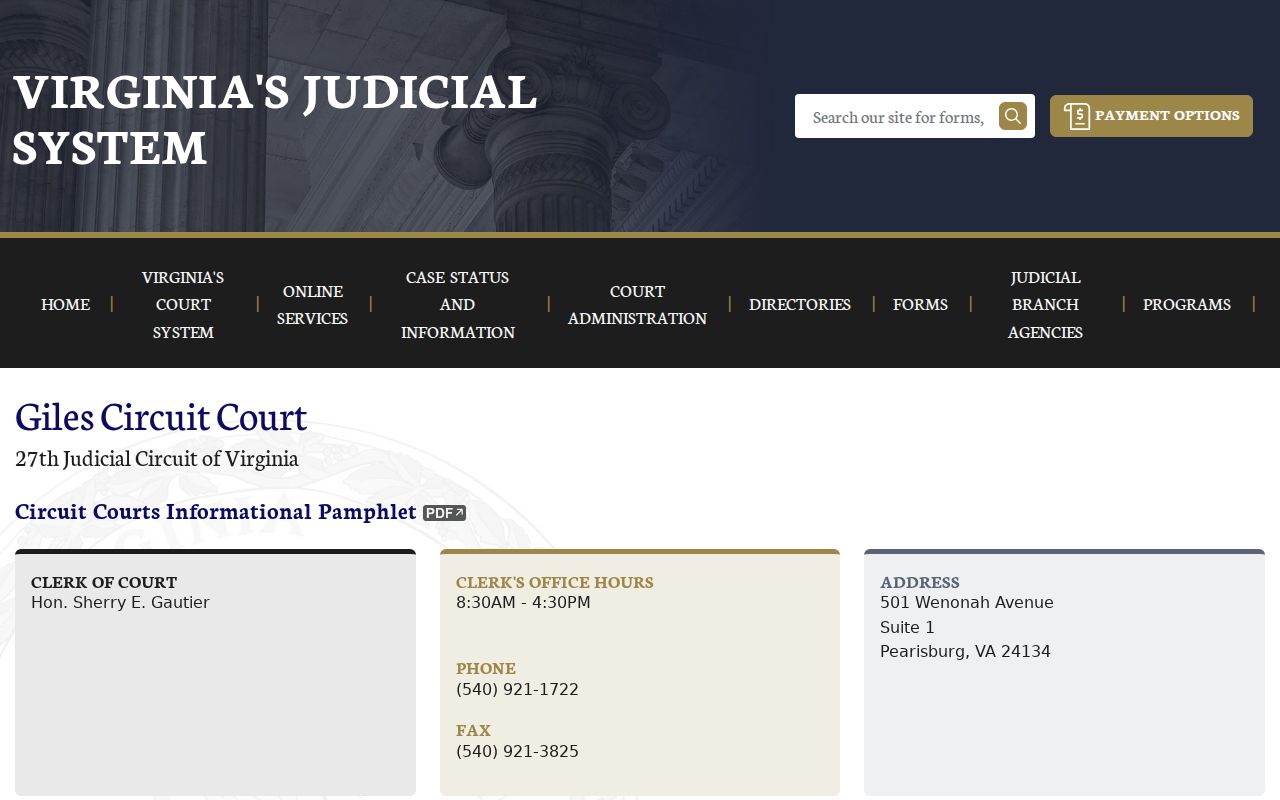
The court page is an office route, not a search of law-enforcement warrant systems.
Arrest Warrants, Summonses, and Bench Warrants
Virginia uses more than one instrument. A summons orders an appearance. An arrest warrant authorizes an arrest, while a bench warrant or capias can follow a missed court obligation. Ask the Giles County clerk to read the exact label and its next date, and see the Giles bench-warrant explanation for related court-date steps.
| Feature | Arrest Warrant | Summons | Bench Warrant |
|---|---|---|---|
| What it directs | Arrest under court process | Appearance at a stated date | Arrest or other court-directed response |
| Common basis | Required probable-cause review | Appearance without immediate arrest process | Missed appearance or specified case process |
| Giles contact | Issuing clerk, then service agency as needed | Court named on the paper | Court that set the missed event |
| Next step | Counsel and court instructions | Attend as directed | Ask about recall, appearance, or bond |
JDR Records Have Separate Limits
Juvenile and domestic-relations cases belong to the JDR Court, which follows its own confidentiality rules. Virginia's self-help material says juvenile case information is not generally available through the public online system. An empty adult search proves nothing. Do not treat it as a workaround. Never seek protected details about a young person. If a case is one you may legally access, call the Giles County JDR Clerk. Ask what information can be released to you. That online boundary reflects privacy law, not proof that no court action exists.
Handling an Arrest Warrant in Your Name
Start with the issuing clerk. Ask for the current case and the exact process label. Then talk through the next step with a Virginia criminal-defense lawyer. The court may require an appearance, bond, or a motion, depending on the case. A signed order controls a recall. A public search does not. A magistrate or judge sets bail terms, and Giles County publishes no universal bond amount or bond-window schedule. Ask where proof must be filed, and keep the receipt or order with your case papers.
Important: Before any voluntary appearance, get legal advice and confirm the court's arrival, bond, and release procedure directly with the proper office.
No Public Surrender Desk Was Found
Giles County publishes no walk-in surrender option. No office here says you can settle a warrant at the Sheriff's Office, courthouse, or magistrate location without facing arrest. The magistrate directory lists only limited in-person coverage. Older contact details have conflicted with it, too. Call ahead before you travel, and remember dispatch will not give legal advice. For clerk, bond, and post-court questions, see the Giles County warrant resolution steps.